Search for

Showing posts sorted by relevance for query paul ekman. Sort by date Show all posts

Are human emotions really universal?

Dongria tribal girl
(Odisha, India)
The English word 'emotion' was adapted from the French word 'émouvoir' (pronounced as 'é-mou-vwa(r)'), back in 1579. The literal meaning of the original French word is "to stir up" or "to move". Emotions have a great power to stir us or move us inside out instantly. Having different emotions is a universal or the single-most common human quality. Expressions of some emotions do magically bridge the huge gaps, cross the international boundaries and bring millions of people together. Hence, we believe that everybody in this world has the exact same emotions as ours. Don't we? Almost everybody does, until an unexpected truth is told.

A few days ago, I watched a presentation on Big Think about human emotions. Among several insights shared by the presenting researcher, three were utterly shocking - 1) (All) Emotions aren't universal i. e. they aren't common across cultures. 2) Facial expressions of emotions aren't universal i. e. they aren't common across cultures. 3) There are no synonymous words for some emotions in the vocabularies of some languages e. g. 'fear'. Indeed, these are entirely upsetting or shocking facts for almost everybody of us who ardently believe in universality, enough to change facial expressions for a long time.

Dr. Paul Ekman (American psychologist) established universality of six basic emotional expressions through his observations with different groups of people, including members of Fore tribe located deep inside the forest of Papua New Guinea. After the same, training programs and tools have been developed on the basis of the same. Especially, those who have built their whole careers, courses, software applications and/or smartphone apps around it would find them very upsetting. Much to their surprise, Dr. Ekman himself agreed about cultural-specific emotions.

Dr. Paul Ekman walking along with
smiling tribal children (1967 - 1968)

These three facts totally disturb what has been taught over the last few decades to millions of people, including law enforcement, intelligence and security professionals around the world. While mentally adjusting with these scientifically proven facts, we need to investigate this deeply 'emotional' subject seriously. Are billions of people really divided into many groups that do experience emotions differently from each other? Or Is it only about the differences in labeling or describing emotions? Or Is it only a translation issue?

After watching the presentation, I started to think really harder over a few days about the three facts. Through this short article, I'm trying to share with you what I've come up with after brainstorming. Especially, if you're a researcher (independent or academic) then I'd kindly suggest to consider the key inputs while conducting further research about this most critical yet complicated subject having global consequences.

Currently, a massive amount of facial data might be getting fed to many Artificial Intelligence (AI) systems for enabling them to recognize different emotions by reading facial expressions. If the same data has been selected by, for and of the members of a specific culture then Emotional AI (EAI) systems might misread the emotions of the members of other cultures by facial expressions. Isn't it totally wrong?

If you could just try to imagine this techno-tragic outcome personally affecting you in the near future then you'd realize exactly how serious are the implications of the belief in 'universality of human emotions (and their facial expressions)'. Actually, the dark rabbit hole goes much farther and deeper inside the ground. Perhaps, only neuroscientists might understand what I'm trying to say.

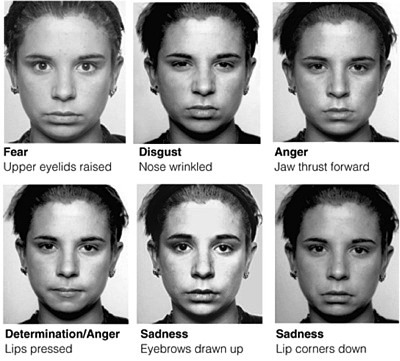
Facial Expressions of six basic emotions
identified by Dr. Paul Ekman

While trying to swallow the three utterly bitter facts very slowly and painfully, we simply can't deny the following possibilities (or realities?):

1) Some commonly shared experiences or inherited memories of some groups or communities have conditioned their members to experience some emotions more profoundly and frequently, in comparison to other emotions.

2) The neural connections and activation inside brains are slightly different in the people following different cultures, who don't experience, express and/or label the exact same emotional experiences.

3) Members of two entirely different types of cultures (e. g. collectivist vs. individualist) don't share the exact same reasons to invoke the exact same emotion e. g. anger (fight).

4) Some physical environments don't leave any reason to invoke some emotions in those who commonly share them e. g. an abundance doesn't lead to greed, envy or jealousy.

5) Some cultures have gradually succeeded in converting some emotional experiences into nonverbal expressions that don't involve facial muscle movements.

6) Some cultures systematically do encourage or educate their members to express some emotions through facial muscle movements, right from early childhood.

7) Some cultures systematically do train their members to completely suppress the nonverbal expressions of some emotions, right from early childhood.

8) Different cultural groups of people do use slightly different facial expressions to convey the exact same emotion e. g. happiness.

9) Some cultures systematically train their members to express some emotions in certain ways, right from early childhood.


For the languages that don't have the words synonymous to 'fear' in their vocabularies, a further investigation is required to prove or confirm if speakers of those languages really don't at all withdraw themselves nonverbally in the presence of a genuinely fearful stimulus e. g. a male tribal hunter accidentally confronting a tiger, a lion or a leopard in the close proximity while hunting wild animals for food.

Also, there's a great possibility that speakers of such languages have been describing the nonverbal expressions of fear graphically, in greater detail to help everybody in understanding the whole scene. How a person expressed nonverbally while experiencing fear might be worth describing for them than just saying "He was in great fear while encountering a tiger at a close distance".

Actually, it's almost impossible that fear (flight response) isn't a single-most universal or a commonly shared emotion. Hence, they might be expressing fear nonverbally and do recognize it as a genuine emotional response. However, they might not be labeling the same experience as 'fear' just like the speakers of other languages having the words synonymous to 'fear'.

An old shaman (spirit-man) from Waura tribe
living in Amazonian rainforest of Brazil

Try to imagine about people living deep inside a large tropical forest. They strictly follow an ancestral culture that greatly respects the territorial rights of the wild animals living in the same forest. How they do react upon sighting a tiger in a close proximity is labeled as 'a display of respect to the protector of forest'. However, the observers not following the same culture might simply label it as 'freezing in fear'.

Actually, screaming, making rapid body movements and running away does provoke some wild animals (big cats and bears) to chase and kill the runner. Hence, everybody is strictly trained by tribal elders to keep both hands steady, maintain total silence, hide weapons, stand still, keep looking ahead with wide open eyes while bending forward. Tigers don't attack them and just pass them by after doing so.

Some emotions could definitely be common across all cultures. However, other emotions or at least the triggering causes of emotional experiences aren't universal. Differences in cultures, conditioning, local environments and/or shared experiences might have led to shaping, modifying, recognizing, categorizing and/or labeling various emotional experiences slightly differently.

Indeed, emotion triggering causes, intensities of emotional experiences, physiological effects of emotional experiences and nonverbal expressions of emotions may not be commonly shared across cultures. Also, they may not evenly be shared, by all member of a family, a group, a culture, a society or a community. They're entirely context dependent or contextual.

Face masks showing different emotional expressions

As a human being, one of the greatest challenge for you is to recognize the different emotions of the people who matter you the most in your life. If you're doing it accurately and timely then you're a good 'mind reader' already. However, your attention to details, contextual awareness and level of empathy are the factors that determine the accuracy.

[#GLOBAL APPEAL: Irrespective of the slighter differences in our intelligence, perception, emotions, thoughts, priorities, motivations, perspectives and experiences; Compassion is the single greatest and universal human quality. It can ensure the continuation of our species while preventing the disastrous outcomes of our ruthless actions, decisions and creations. However, our passive optimism isn't doing anything for us and it never did. We need an active optimism.

While Artificial Intelligence (AI) systems are still growing, learning and developing within human control (hopefully!), it's a greatest moral responsibility of all whistle-blowers, organizations, governments, politicians, institutions, journalists, philosophers, agencies, academics, researchers, scientists, developers, futurists, influencers, thinkers, leaders and experts to unite for creating boundaries, regulations, rail-guards, brakes, limits, ethics, rules and/or laws.

We won't get a second chance to do the same in future. That's why we all need focused, resolute, unanimous, consistent, collective, committed, coordinated, transparent and accountable efforts taken at a global scale.

Are we not at all answerable to our own children and next generations?
]


Related Articles:
1) Chicken and Egg Paradox 2) Basic Emotional Expressions 3) Would aliens have emotions? 4) Can body language reveal thoughts? 5) Is Human Communication 93% Nonverbal? 6) Artificial Intelligence and Body Language 7) Human Interactions in AI Era 8) THE END of OVER-Generalization

Why women apply makeup on face?

Around 4,000 years ago in Egypt, pyramid workers went on the strike for a reason that might sound unbelievable for most of modern population. Those workers went on strike because they were running out of makeup. Yeah! Only a thin layer of cream prepared from herbs, fruit extracts and fat protected their skin under harsh temperature and intense sun rays in the desert.

In fact, today's modern skin creams, conditioners and sun blocking (SPF) lotions have almost the same ingredients, with few additions by cosmetic manufacturers to allure their customers. Thanks a lot to the ancient Egyptians for inventing makeup and the pyramid workers for using it perhaps at the first time in the human history!

Due to invention of fabric and textile and growth in cloth manufacturing, we are able cover our skin and body parts to protect them from sun rays, cold, rain and snow fall. Unlike barely clothed pyramid workers, we shouldn't need to put on makeup in modern era. However, modern women spend a lot of money and time on makeup, both at home and in beauty parlors.

For many husbands in the modern world, it’s quite irritating to wait for hours for their wives who are busy applying makeup while sitting in front of mirrors with bunch of bottles, brushes, tubes and containers. If you ask to your wife, she may not be able to answer that why she applies makeup in the first place.

Why women apply makeup on face? For them, it’s not about to protect skin most of the time but what men unconsciously want them to look like. Isn't it sounding strange in the first place? Let’s check that why we all love little kids and what exactly for.

Large eyes, very thin (and almost invisible) eyebrows, thin eyes lashes, silky soft and curly hairs, spotless and evenly toned skin, smooth and full lips and puffy cheeks that turns red after getting emotionally aroused. Isn’t it cute?

These facial features are survival gift from our evolution to human babies and we all tempt to protect and pamper them because of the same. Cuteness of a human child plays almost the same role in youth for (fertile) women.

Indian bride with makeup
If we closely examine a single or the whole group of makeup products, they help women to mimic the baby face. Products like foundation, moisturizer and face powder offers spotless, soft and tight skin and also hide uneven counters, pigmentation, wrinkles, dullness and dark spots.

They turn most of facial skin into a canvas by which attention of an observer can be drawn to most attractive and appealing features of face i. e. eyes, cheeks and lips. They play very dramatic and nerve sparking role during courtship and romance. Bridal makeup can transform an ordinarily looking girl into a queen who woos his groom.

Eye Liner, Kajal (Indian eye liner) and Surma (Middle-Eastern eye liner) draws outlines of eyes to make them look very large and attractive. Plucker and Eyebrow Pencil shape eye brows to look very thin, curvy and dark. Concealer hides wrinkles and dark circles under eyes. Eye Shadower paints area between eye lids and eye eyebrows to look darker to convey state of submission and tranquility during romance (Reference: Paul Ekman). Mascara makes eye lashes more thick, long and curly.

Blusher paints cheeks as if they convey the state of arousal and excitement. Flushed cheeks also convey innocence, excitement and shyness during courtship (Reference: Paul Ekman). Lip Liner, Lip Stick and Lip Gloss makes lips more attractive and appealing and also to look big if they are naturally thin and vice a verse. Flushed lips convey vitality of a woman (Reference: David Buss).

Bollywood actresses before and after makeup
(Courtesy: msn.com)

What we see is what we likely to believe by the most and therefore the makeup achieves the same. If somebody looks at a young woman at very first time and from an observable distance with facial makeup out on, it unconsciously compels the person to assume its her natural look.

Applying makeup is all about of creating artificial effect of cuteness, infantility, vitality and fertility. Moreover, contrasting colors and shades bring very dramatic effects and thus helps making a face look more appealing to an observer, especially the first timer.

If you want to witness the power of makeup then don't miss to carefully observe the great difference between body language of women and especially actresses before and after makeup.

[Critical Note: This article doesn’t advocate the widespread practice of applying makeup and also doesn't promote the massive usage of the artificial makeup products at all. Therefore reader’s discretion is kindly solicited before arriving to any conclusion.]

Related Articles:
1) Primary Attraction 2) Body Language with Poor Body Image 4) Woman's Courtship Body Language (Part 1) 4) Woman's Courtship Body Language (Part 2) 5) Courtship and Dance 6) The ways woman provokes her man to be protective

Basic Emotional Expressions

When it comes to talking about body language, facial expressions come first because our eyes pick the muscular movements given away by the face on which they're located. Paying attention to the face and facial experssion is obvious due to the peculiar location of eyes. We pay a lot of our attention to the way our entire face move its muscles.

According to renowned American psychologist Prof. Dr. Paul Ekman, seven basic emotions are widely experienced in different human cultures across the whole planet. Expressing emotions is not required to be taught. It's an autonomous process and we all inherit from our remote common ancestors.

Apart of the seven basic emotions, all other emotions (and their expressions) can be classified under a single emotion or a combination of two different emotions. For example, aggressiveness is closely related with anger whereas nervousness is combination of fear and sadness.

Don't forget to watch below YouTube video of Dr. Paul Ekman himself talking about the emotions - their evolution, purpose and sensory stimulus.


1) Fear: It’s a state of preparing to run away from imagined or actual warning or danger.

Eyebrows tensely get curled, shoulders fall down, neck gets stiff, eyes stay focused or averted, blinking goes up, eyes get widely open to let more light pass to retina, mouth opens wide to let more air pass to lungs, vocal tone trembles, respiration soars, heartbeats go up, face becomes faint, throat gets dry and saliva’s swallowed, torso lowers, stomach gets pulled inside, whole body starts sweating and shivering, hands appear muffling the mouth to suppress scream, body hides itself behind something and feet gets ready to flee.

2) Anger: It’s a state of preparing to retaliate, oppose or punish somebody. 

Whole body is tightened or bluffed to appear bigger and hostile.

Eyes get wide open, body temperature starts rising, eyes stay focused, short darts move all over target, neck gets stiff, face and eyes turn red, shoulders spread wide, torso elevates, chest puffs, nostrils flare, respiration soars, pulse jumps, lips get tightly closed or opened, teeth get exhibited, vocal tone becomes fierce, feasts get clenched, arms get crossed over chest or rest on hips, feet get firmly grounded and separated apart to prepare for attack.

3) Disgust: It’s a state of exhibiting loathe or lack of interest about a person or an object.

Torso and face turn away, eyes become faint, heartbeats drop, gaze becomes more fleeting than fixated, mouth gets opened on either side, lower lips push out, tongue protrudes, nostrils pull upward, breath exhales briskly, throat clearing sound generates, sounds like “Yuck”, “Whack”, “Ooom” expel from mouth, vocal tone gets dull, hands push or hold the source of disgust away.

4) Sadness: It’s a state of disapproval or physical exhaustion to make person appear in a demand of others' attention and support.

Posture doesn't remain stiff, responses dampen, neck hangs loose or tilts side way down, hands support neck or cover face, shoulders come closer, respiration rate drops, eyes hover around own body, eyes barely open, lower lip pushes over upper lip, edges of mouth curl down, palms clamp together and rest on lap or hid in pocket, vocal tone becomes dull - heavy and sluggish, sounds like “Hmm”, “Whoosh” expel from mouth.

5) Surprise: It’s a state of hyper curiosity and great attention being paid to object, person, situation or phenomenon that is unexpected, inexperienced or takes place suddenly.

Eyes get wide open to let more light pass to retina, eyebrows raise, neck remains straight or tilts backward, mouth gets wide open, lips get rounded, hair raise, jaw drops, vocal tone accentuates, sounds like “Wow”, “Ohh” expel from mouth, torso gets raised, hands are kept in ready position, whole body faces and points partially or fully towards the source of surprise.

6) Happiness: It’s a state of expressing and enjoying some kind of achievement, benefit, fulfillment or victory. 

Whole body starts sending message of excitement, open and outgoing or sharing temperament.

Body raises upwards, footsteps appear flying, movements become energetic, facial muscles get relaxed, mouth opens, edges of mouth curl upward, teeth get partially or fully exhibited, eyes glitter, gaze remains more upward or ahead and away from body, palms gets open and held upward, hands get separated and are raised shoulder high or above, vocal tone gets crunchy - chirpy - sweet, sound like “Ha…Ha...Ha...”, “Hurray…” “Ho...Ho…”, “Hey...Hey...”, “Yeah”, “Yippee…”, “Yee Haw” expels from mouth.

7) Contempt: It's an exhibition of self-evaluated superiority i. e. assumption about oneself as better than the other (in some areas) or an utter dislike.

Unlike other six basic expressions, contempt is expressed consciously or thoughtfully and mostly on face.

Eyes are narrowed, lips tightly press together, either edge of mouth gets pulled upward appearing like an asymmetrical smile, sound like "Hhhhh" rapidly expels from mouth.

Either or both edges of lips deeply pinched inside cheeks is also an expression of contempt.

Related Articles:
1) Survival of communicator 2) "Nonverbal" is alien way of communication? 3) "The expression of emotions in man and animals" 4) Evolution of Nonverbal communication 5) Emotional expressions are manipulated 6) Emotional Intelligence and success 7) Women are body language experts8) Genius of acting 9) Observation is the key 11) Body Language Brain 12) Common Facial Expressions 13) Common Hand Gestures 14) Fear Factor 15) Indian Classical Dances 16) Is learning micro expression really useful? 17) Botox hampers emotional awareness 18) Recognizing emotional expressions: Scientific viewpoints 19) Should leaders show emotions? 20) Blind Sight is enough to pick emotions 21) Basic responses in stressful situations 21) Are human emotions really universal?

Is Learning micro expressions really useful?

For years, we have been hearing about the importance of micro expressions when it comes to recognizing emotions accurately. Ever since the 70's Prof. Dr. Paul Ekman began his groundbreaking research in this area, there has been an intense debate about training and developing an ability to recognize micro-expressions.

Following several articles published in media emphasizing of micro-expression training, there are many other that raised contradictions. Therefore, here I present a very interesting article.

Micro-expressions (Courtesy: Dr. Paul Ekman)

The research was conducted by two professors of social psychology namely Dr. David Matsumoto and Dr. Hwang Sung at the State University of San Francisco, United States of America. Another interesting factor was that the investigation by the university was funded through a grant from United States Army Research Institute for the Behavioral and Social Sciences (USARI) and Air Force Office of Scientific Research (AFOSR).

This work is notable because it presents scientific evidence of the effectiveness of training to improve the ability of emotional recognition through micro-expressions.

In the first study, several people belonging to sales profession participated in a conference in which they were given basic knowledge on emotional recognition. These people were divided in two groups. One of them received an additional training session 60 minutes by a trainer experienced.

This group was compared with the other one that received no additional training. The results showed an ability to recognize micro expressions significantly higher in the group of additional training in comparison with the other group.

This finding was particularly notable for two reasons:

1) Both groups were equivalent in their knowledge of emotions because both received basic information on emotional recognition. However, one group received additional training workshop and other did not.

2) The impact of the training program not only demonstrated in emotion recognition tasks but also produced significant social and communication according to an assessment by third participants two weeks after the program.

The results of the "Study 1" were further reinforced by the results of the "Study 2" that demonstrated the effectiveness of the training program after a period of time after training.

In the second study, participating lawyers and psychologists split into created two groups. First group received training in recognition of micro expressions and another did not.

Three weeks later, a test was conducted for trained group and untrained group for comparison. The trained group was significantly better in emotional recognition than the other. Moreover, they responded to emotions faster i. e. response time (latency).

These findings are important because they show that people can be trained in recognizing micro expressions and also same capacity can be retained over time.

The authors says in their conclusion that that the scientific evidence presented in these studies provided the evidence necessary for those interested in understanding the emotions of their partners.

If you interact daily with other people and want to understand them better, training in recognizing micro expressions is a very interesting option to consider.

Undoubtedly, this research was very important for international scientific community.

[This article is translation of the original article "Entrenamiento para reconocer emociones a través de las microexpresiones, ¿ayuda o pérdida de tiempo?" written in Spanish (Español) by my friend and a nonverbal communication researcher Prof. Dr. Rafael López Pérez from Universidad Camilo José Cela, Madrid (Spain).

Just like facial expressions in body language, facial micro-expressions have been a great subject of research, especially through behavioral forensic and psycho-analytical perspective.]

Related Articles:
1) Basic Emotional Expressions 2) Micro Expressions 3) Recognizing emotional expressions: Scientific viewpoints

Gestures: Are they learned or genetic?

Along with Prof. Dr. Paul Ekman's bench-marking work that proved the universality of facial expressions of basic emotions, prevailing behavioral researches in world of psychology are attributed to human nonverbal communication.

The strength of the contributions made by of Dr. Ekman has left no room for any doubts and today no one questions that basic emotions have a universal facial expression pattern that is contained in our genetic makeup.

However, what about the gestures we make by hands or head? Are they learned or genetically inherited? Let's find out what a research says.

My approach in this article is taking you attention to a research conducted by scientists at the Max Planck Institute for Evolutionary Anthropology in Leipzig (Germany) that has recently been published by BBC Science.

Group of wild bonobos: Closest primate cousins to humans

According to scientists and as they managed to film on many occasions, several members of primate species called as Bonbons shook their heads from side to side to prevent others to do something they didn’t want. In one of the recordings, a mother shook her head to stop her baby playing with food.

Researchers say that this could be a precursor to the behavior of shaking head used by humans observed in one of our closest primate relatives. Chimpanzees seem to shake their heads to avoid behaviors that do not satisfy.

"Our observations are the first to report the use of negative movement of head in bonobos," says Christel Schneider, who led the study. According to his research, the recorded videos in Leipzig Zoo, a chimp mother shook her head in disapproval of playing with food by her baby.

"Ulindi is trying to prevent her daughter, Luiza, keep playing with a piece of leek", explains the researcher. "As Luiza ignored, despite repeated attempts to stop her, Ulindi finally shook his head at the young," he adds.

"No" from Bonbons

It is known that African great apes such as Bonobos (Pan paniscus) and Chimpanzees (Pan troglodytes), nodding used as negative (tilt or shake) to communicate with other members.

It was already known that bonobos use head shaking to initiate interactions with other members of their group and start playing. However, this is the first study that shows in films that an ape shaking his head in a negative context, to avoid or prevent other bonobo’s behavior.

Scientists based in Germany observed this behavior when the animals were being analyzed as part of a larger study about communication of offspring of the great apes.

With video cameras recorded the gestures and behavior of bonobos, chimpanzees, gorillas and orangutans in six European zoos. During the investigation, they found four bonobos shaking their heads in this way on 13 different occasions. Previously there were only anecdotal reports of chimpanzees shaking his head to indicate "no."

Socially Sophisticated

Scientists believe that the negative head movement is a precursor of the same behavior in humans. Scientists explain that bonobos use a wider range of head gestures than chimpanzees and are considered to be more sophisticated to use their head to indicate any meaning.

The authors say that these sophisticated systems of communication might have arisen because of apparently sophisticated society, tolerant, cooperative and democratic living in these animals where complex social structures and hierarchies diffuse. So perhaps bonbons developed the head nod to say "no" and negotiate conflict situations.

However, researchers are cautious and say they cannot be sure that the animals really want to deny when they shake their heads in this way. But so far this is still the best explanation, they say.

Also, as Schneider told to BBC, we must clarify that the head movement is not always associated with something negative. In many countries, moving head side to side is symbol of approval too.

[This article is translation of the original article "Gestos, ¿aprendidos o genéticos?" written in Spanish (Español) by my friend and nonverbal communication researcher Prof. Dr. Rafael López Pérez from Universidad Camilo José Cela, Madrid (Spain).

Just like facial expressions and facial micro-expressions in body language, hand gestures have been a great subject of research, especially through technological development perspective.]

Related Articles:
1) Basic Emotional Expressions 2) "The expression of emotions in man and animals" 3) Body Language Brain 4) Why we clench fist after victory? 5) Self-communication by gesturing 6) Basic Gestures: Best Survival Tools for Travelers 7) Cultural connection behind gesturing

Indian Classical Dances

All Indian classical dance forms are really great not only to watch and enjoy but also to understand the greatest influence of nonverbal communication in our daily lives. They mesmerize audience and keep their attention focused on dancers and drama they play out. Their costume add to the overall effect their performances want to produce and impression they want to leave on the minds of audience.


Dancers often enact as mythological story tellers or actual characters of the story on the stage. However, they can convey message related to different subjects from the real life and current affairs too. They can portray virtually any tangible or intangible entity and concept we have ever invented or imagined so far. Animals and creatures are also included in the acts.

They thoroughly utilize facial (micro) expressions, postures, gestures, emblems, proxemics and body movements to enact their roles very lively and dramatically. It always results into an overwhelming performance. Many western performing artists have invented or developed hybrid dance forms by taking an inspiration from Indian Classical Dance forms.

With charismatic costume, jewelries, accessories, body decoration, make-up and music; each dance form is unique by itself. Still, they are are strongly connected with each shared aspects like exuberance, sophistication and dedication.

Following are the Indian Classical Dance forms:

  • Kathak (कथक) - Classical dance from Northern India, inheriting few aspects from Persian (Iranian) and Central Asian dance forms
  • Bharatanatyam (भरतनाट्यम) - Classical dance from the state of Tamil Nadu
  • Kathakali (कथकली) - Classical dance from the state of Kerala
  • Kuchipudi (कुचीपुड़ी) - Classical dance from the states of Andhra Pradesh and Telangana
  • Manipuri (मणिपुरी) - Classical dance from the state of Manipur
  • Mohiniaattam (मोहिनीअट्टम) - Classical dance from the state of Kerala
  • Odissi (ओडिसी) - Classical dance from the state of Odisha
  • Sattriya (सत्रिया) - Classical dance from the state of Assam

  • Like different elements of body language, these dance forms also use various elements to express physical, emotional and social status and conditions. Their original names are in Sanskrit language as described in Natya-Shashtra (नाट्य शास्त्र) i. e. an ancient Indian treatise on the performing arts (theater, dance and music).

    Basic elements of all Indian Classical Dance forms are: 1) Kaaranas (Transitional movements or postural alternations) 2) Hastas (Hand gestures) 3) Adavus (Series of movements or expressions) 4) Bhedas (Eye contact, different gazes and neck/head movements)


    Dr. Paul Ekman discovered the universality of facial expressions subjected to seven basic emotions in 20th century. However, Indian classical dancers have been portraying Nav-Rasas (Nine distinct psychological states or emotions) on their bodies and faces since thousands of years. Perhaps, Dr. Ekman himself might have taken the inspiration from the same.


    Nine different facial emotional expressions include in Nav-Rasas (Nine Emotions) are Shringara (Love, Affection or Amour), Hasya (Happiness, Enjoyment or Laughter), Karuna (Kind-heartedness, Empathy or Compassion), Raudra (Anger), Veera (Valour), Bhayanaka (Terror), Bheebhatsya (Disgust), Adbutha (Surprise) and Shantha (Peace or Tranquility).

    Actually, these nine distinct psychological states or emotions can't be fully expressed without involving the entire body in the process. Especially, both body posture and hand movements change dramatically between one emotion to the other. You can watch full body portrayal of nine emotions right below.


    According to me, Veera (Valour) is almost equivalent to the emotional expression of Contempt. There're shared similarities like flexing neck, looking forward, standing/sitting straight and expanding body. If you just add an asymmetric smile or scorn to expression of Veera (Valour) then both would appear exactly the same. Wouldn't they?

    Not just Asians, Indians or people of Indian origin but also many notable artists, researcher and scholars across the globe are inspired from classical dance forms of India.

    Watch this YouTube video briefly demonstrating the power of Mudras (Expressions and Gestures) to portray different elements in dance.


    Related Articles:
    1) Basic Emotional Expressions 2) Courtship and Dance 3) Genius of acting

    Recognizing emotional expressions: Scientific viewpoints

    It is said eyes are window of the soul but actually entire face convey emotions and psychological state. Reading facial expressions is considered as a pinnacle of emotional nonverbal communication. Not only emotional signals but also physical states and cognition related clues are conveyed by human face. What is science behind this?

    Seven basic emotional expressions and
    a neutral face (in bottom right corner)

    Until we don’t understand different theories and factors related with emotions and their expression, it’s really hard to be able to recognize them in different contexts. Neuroscience and social psychology have great impact on our ability to express and also pick emotional clues from somebody’s face (and body).

    Pioneers and their discoveries

    Sir Charles Darwin initiated the study of emotional expressions in humans and animals. Through his book The Expression of Emotions in Man and Animals, he gave us a great insight about emotions, their origin and corresponding facial expressions. According to him, emotional facial expressions are ancient remnants of different physiological states that our ancestors might have gone through.

    Different facial expressions might have benefited them in past so we kept inheriting them through generations. He believed that nonverbal expression of emotions is species specific and not cultural specific. Darwin emphasized greatly on decoding emotions by detecting combination of movements by different (facial) muscles. He also succeeded in creating codes for muscular movements related with different emotional expressions.

    In 20th century, Prof. Dr. Paul Ekman and Wallace Friesen traveled to Papua New Guinea to prove ground breaking theory i. e. Universality of facial expressions related to basic emotions. According to them, there are some specific cross-cultural patterns of facial muscular movements corresponding to Fear, Anger, Disgust, Surprise, Sadness, Happiness and Contempt.

    They studied and analyzed seemingly primitive population which was totally cut off from modern world. Despite of geographical and cultural isolation, those preliterate people expressed emotions on their faces in almost same way other people do in their own cultures. Moreover, people from other cultures could easily pick emotions on faces of Papua New Guinean people. Indeed, it was an amazing discovery.

    Advantageous Expressions and Facial feedback

    According to later theorists, expressions related with difference emotions might have offered us three distinct advantages during social interaction: honest communication, deceptive communication and regulation of emotions by through facial feedback.

    A) Honest communication of emotion in which facial expressions are result of genuine neurological (or limbic) processes that take place when we’re exposed to sensory stimulus. Honest emotional communication is crucial for survival of any creature and not us. It alters physiological symptoms involuntarily and guides to act or behave according to reflexes that guarantee or multiply opportunities of survival.

    For example, if our ancestors wouldn’t have run away after watching a tiger approaching them then they would have died or got seriously injured. Even today, if a child doesn’t omit distasteful thing out of its mouth by making disgusted face then probably it would pose harm to child.

    B) Deceptive communication is mode in which sender tries to mislead receivers about its true psychological state. It definitive would have given certain advantages to our ancestors throughout evolutionary history. For example - a leader of tribe portraying anger on his face could derogate sub-ordinates and kept them under control without engaging into physicality and wasting energy.

    We experience that a child can easily draw attention of her mother through fake weeping. However, deceptive emotional expressions can easily be detected because they are not congruent with context.

    C) Emotional regulation by controlling facial expressions helps us to alter the severity of emotional perception. On the other hand, conscious movement of facial muscles can induce same emotion in mind of subject (the person who does it) and other people. In one experiment, it has been found that people who controlled painful expressions felt less pain as compared to those who let their faces express pain in natural and uncontrolled way.

    Social or polite smile is a good example of facial feedback theory because it helps in creating favorable environment for person who initiates it. There's no surprise that a smile is the most commercially capitalized aspect of the overall body language.

    It’s highly observable that we tend to express both genuine and fake emotions more intensely in presence of other people as compared to solitary mode. We need receivers or audience for conveying our psychological states because expressing them would be useless and wastage of energy in absence of people.

    On the other hand, we also try to conceal true emotions or mask them by expressions of more socially acceptable emotion as part of display rules that are either inherited or learned.

    Related Articles:
    1) Basic Emotional Expressions 2) Body Language Brain 3) Micro-Expressions 4) Is learning micro expression really useful? 5) Emotional expressions are manipulated 6) Botox hampers emotional awareness 7) Facial Feedback: World smiles with you! 8) Should leaders show emotions? 9) Are you a 'flying' terrorist?

    Why we smile?

    Grimacing monkey
    A smile is a magical tool in human society. It helps in winning people’s hearts and draw sympathy and favor. Smiley and emoticon have become integral part of text messaging and chatting applications around the world. We feel quite better when somebody smiles at us and we smile in return. Smiling person is like and loved the most than the one who presses lips tightly and glares at you.

    Why we smile at each other so instinctively i. e. without training, instruction or compulsion? The answer to this question is both exciting and bizarre. My very own hypothesis about its origin, briefly titled as "Harmless Teeth" is as following. Please don't forget read it till the end.

    Very few of us might know that our primate cousins (apes and monkeys) also smile at each other. When two primates stand in front of each other or pass along side, they open their mouths slightly so that their teeth should get displayed. In their society, smiling has a lot to do with social harmony, dominance and survival. Smile has almost similar value in human society too.

    Dr. Paul Ekman
    expressing anger
    By doing this, they make each other feel safe by passing a message, “Don’t be afraid! I’m not baring my teeth at you. I’m friendly!”. It's only the dominant male in their group who doesn't show his teeth to others. He uses his teeth only to bite and injure his sub-ordinates or rivals to proclaim his superiority or control.

    In face-to-face encounter, direct eye contact made with enlarged eyeballs and pressed lips is a classical sign of threatening, intimidation or hostile intentions. If any person is confronting to such kind of eye contact made by others for a considerable amount of time, it’s assured that it would result in either running away or retaliation through Amygdala Hijack.

    Elongated hostile gaze leads to parasympathetic distress and our primate cousins use same strategy smartly. Dominant male gorillas stare with hostile facial expressions to control a large group of sub-ordinates and to deter rebellions or rivals. It's a sort of territorial invasion with eyes and also an invitation to fight.

    According to my hypothesis, ritual of smiling is comparatively less related with lips and teeth than eyeballs and gaze. Orbicular muscles (Orbicularis Occuli) around the eyes unconsciously contract while smiling to convey that an individual is afraid of other person(s) during face to face encounters, confrontations and interactions.

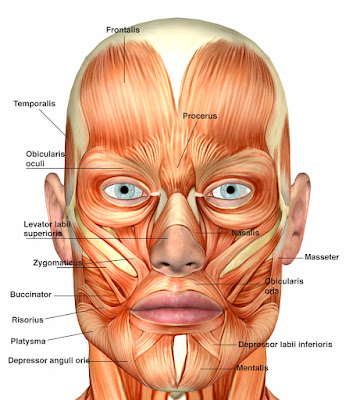
    43 different facial muscles

    Displaying teeth along keeping eyes smaller in appearance creates overall effect of harmless intentions. Otherwise, displaying teeth by opening lips but deliberately keeping eyes wide open at the same time simply looks comic, weird and frightening. Also, clenching jaws and displaying teeth by opening lips at the same time also doesn't create the expected effect of harmless intentions.

    Additionally, contracted orbicular muscles help in protecting eyes from possible attack and also reverse the effect of the stronger, hostile and dominating gaze i. e. our eyeballs appear smaller than their normal size. Along with the same, separation of both lips and turning their corners upward might have evolved to enhance orbicular muscles (Orbicularis Occuli) contraction.

    A thin band of Zygomatic muscles on both side of face arising from Zygomatic bone i. e. near the outer edges of eyebrows and merging into Orbicularis Oris muscles (circular muscles around lips) at both corners of mouth contracts and pulls the edges of lips upwards while we smile. Also the puffed cheeks due to this pull provide an additional protection to eyes.

    Air hostesses smile a lot during the flight
    to keep the distress low in the passengers.

    Smiling or looking at the smiling faces associated with Endorphin (a neurotransmitter) secretion. It induces feeling of happiness in mind even if smile is genuine or fake one. We portray different kinds of smiles for expressing appeasement, acceptance, approachability, innocence, happiness, friendliness, agreeableness, fondness etc. All of these facial expressions are non-threatening for others.

    Very shocking it might sound for most of us but we can portray 43 different kinds of smiles. Also, a smile is the most commercially capitalized aspect of the overall body language.

    [#Special Note: This articled has been accepted by, translated into Spanish (Española) and posted on Evidentia University (Behavioral and Forensic Sciences) website. It's URL is https://evidentiauniversity.com/es/blogs/clublenguajenoverbal/por-que-sonreimos]

    Related Articles:
    1) Why we wave hands at others? 2) Positive body language 3) Making true friends 4) Woman's courtship Body Language (Part 1) 5) Woman's courtship Body Language (Part 2) 6) Primary Attraction 7) Why we hug? 8) Genuine Smile 9) Child inside us 10) Importance of Touch 11) Asymmetrical Smile but not Contempt

    Reading Body Language - Micro Expressions

    Lie to Me (the world famous TV serial) made common people aware about how ability to detect tiniest movements of facial muscles could bring dramatic turn while interrogating the suspects. Bringing a criminal into confessing crime it committed isn't easy because it tries to defend itself from being detected by the law enforcement agency.

    Exactly like the crime investigators, forensic experts and criminal profilers pick, photograph and document the tiniest clues from the place crime took place, interrogators have to do the same by picking tiniest expressions from faces of people they interrogate, question or try to get information from.


    A micro-expression or micro-momentary facial expression is nothing but the expression of different emotions that unconsciously occurs within fraction of a second. Just like a macro or clearly detectable facial expressions, micro-expressions convey what is being suppressed by an individual.

    With experience and age, people learn to control autonomous facial expressions, movements and gestures by giving away clues about them momentarily. A novice or inexperienced observers can and do overlook micro-expressions because they remain almost undetected by untrained eyes.

    Who says I'm afraid?
    Unlike normal, macro and subtle expressions; micro-expressions do appear and disappear within fraction of a second on human face, from 1/25 to 1/5 of a second. For inexperienced or untrained observers, it's close to impossible to pick the micro-expressions.

    Analysts, experts and interrogators who are expert in picking them can instantaneously crack or zoom into micro-expressions in real-time. Also, micro-expressions can be monitored while running a video clip at lower frame rate or watching a photograph.

    Micro expressions can bring surprising turns while interpreting body language because they are emotional outlets of actually what somebody is trying to suppress or hide from others. Learned and volunteer control (cortical control) still let their trails appear as much as for 1/4 fraction of a second as per pioneer emotion and facial expressions scientist Prof. Dr. Paul Ekman (University of San Fransisco, United States).

    Did she kill her husband?
    Experienced interrogators and lie detectors mostly rely on micro expressions because smart liars can confidently claim that ordinary people easily believe in. In a real incident, a suspected woman was arrested for the murder of her husband.

    During the police interrogation, she boldly claimed, "I really don't have any idea about him. I hope that he'll come back very soon". However, she unconsciously gave away a subtle clue that as ordinary individual would have ignored and wouldn't have ask any serious questions to her.


    While claiming the same, she turned her face contemptuous, just for fractions of a second. If she really cared about her husband then why she expressed disrespect (towards him) in the first place? Experienced interrogators would sense that something must have gone wrong in their relationship.

    Expert interrogators could have possibly get her confession of murdering his own husband by asking a few serious questions about their relationship status to establish her motive. Hence it's always worth remembering that the devil is in the details.

    In May 2013, I got a certificate from Humintell for completing facial micro-expression training and passing the final test with 93% percent of accuracy. Although I passed with ‘Expert’ level, it wasn’t an easy task at all because the mood of an individual at given moment and the ability of moving own facial muscles can make a great difference.

    Therefore, I can assert that my own facial muscles helped me in passing this test in the very first and also a single attempt with the greater accuracy. Ability to portray micro-expressions on your own face can give you the real advantage and the edge in identifying them on faces of other people.

    My Certificate from HuminTell

    Are you good at picking micro-expressions? You can test your skills by following this link that takes you to a demo test. The test is also available below. Try yourself and know your score. Taking this test on a desktop computer is highly recommended.

    Related Articles:
    1) Body Language Brain 2) Clusters 3) Congruence 4) Proxemics 5) Context 6) Para Language 7) Postures 8) Facial Expressions 9) Hand Gestures 10) Challenges 11) Interpretation 12) Baseline 13) Perceptual Bias 14) Is learning micro expression really useful? 15) Nonverbal Clues of chess players 16) Recognizing emotional expressions: Scientific viewpoints 17) Blind Sight is enough to pick emotions 18) Are you a 'flying' terrorist? 19) Basic Bodily Clues

    Reading Body Language - Common Facial Expressions

    When it comes to talking about body language, facial expressions come first because our eyes pick the muscular movements given away by the face on which they're located. Paying attention to the face and facial experssion is obvious due to the peculiar location of eyes. We pay a lot of our attention to the way our entire face move its muscles.

    The face we see everyday in the mirror isn't given thought to seriously but human face is unique among all animals living this planet because it can express various emotions, feelings and moods by moving its muscles. Surprisingly, we all express them in a quite similar manner because we inherit them from the common group of ancestors.

    43 muscles of our face help us to portray over 10,000 different configurations, including emotional facial expressions, emblems and gestures. Prof. Dr. Paul Ekman has made a great contribution in scientific area of facial expressions and their decoding through FACS (Facial Action Coding System).

    Different Facial Muscles

    Following are some common expressions (including basic emotional expressions):

    Enjoyment

    Fear

    Focus

    Anger

    Disrespect

    Disgust/Dislike

    Happiness/Enjoyment

    Nervousness

    Calmness/Serenity

    Sadness

    Disappointment/Contempt

    Worry/Nervousness

    Jealousy

    Hurtfulness

    Amazement/Surprise

    Weepy

    Related Articles:
    1) Basic Emotional Expressions 2) Body Language Brain 3) Clusters 4) Congruence 5) Proxemics 6) Context 7) Micro Expressions 8) Para Language 9) Postures 10) Hand Gestures 11) Challenges 12) Interpretation 13) Baseline 14) Perceptual Bias 15) Botox hampers emotional awareness 16) Basic Bodily Clues