Search for

Body Language cues of Chess players

Recently, my three colleagues and I appeared in a quiz competition. It was based on general knowledge in area of science, geography, history and sports. There were three rounds and there were entirely different querying formats in each round. Most of them were really wonderful and challenging which I never heard about before.

Even if we were recalling our memory to tackle different sort of questions, we had to keep ourselves in a control and remain coordinated to avoid giving wrong answers in both excitement and uncertainty. Our faces and bodies were giving out some clues that we and others could easily pick.

Stroking chin, scratching head and touching different part of face was obvious.However, in such kind of team activities, it’s really hard to keep each other in sync for better performance. Both win and loss is shared by each team member so personal stakes are quite less. Throughout the competition, it gets reflected through body language of whole team members.

We all know that being in a team is really good to compete but what about competing on your own, all alone? In this situation, individual's own body language speaks at great volume. Those who are good observer can easily pick both distress and delight clues given away by the players.

Yesterday, I went to watch a chess competition organized by my company. It was a small competition and many friends were competing to make their challenge to the next round. Watching chess matches on television (which I never did yet) and in still photographs is entirely different than watching players in a close proximity.

When people you know from several years participate in any competition and face any challenging situation, it definitely occupies some space of your mind due to the relations developed with them over the period. It affects the emotional resonses of an observer and ultimately - its body language.

Probably, you might know that the game of chess was originally invented by Indians, during Gupta Empire (early 4th century CE to late 6th century CE). In ancient era, people of India used to call it as Chaturang(चतुरंग) which means means 'four-limbed' or 'four arms', referring to ancient army divisions of infantry, cavalry, elephantry, and chariotry.

It can be entirely mythical that Chaturang or Chess was used to be played with the real men in different characters standing on a large board (painted or marked on ground) and two competitors controlling their moves. Perhaps, today's chess board and pieces might be an exact replica of the same arrangement. Unlike poker or card game, playing chess takes lot of mental energy because both competitors can watch each other’s move.

Vishwanathan Anand (India)
Chess board has 64 houses and each player has to compete with the help of 16 pieces belonging of different characters and having various tactical abilities. Players have to keep their emotions under control (which is really a hard part) to remain into game without loosing concentration and tactical edge.

What exacly our brain needs to in the face of intellectual challenges? It direly needs more supply of blood, oxygen and suger to keep working until we win or give up. Body makes its arrangement itself by adapting a perticular posture to increase their supply to the brain.

We can easily figure out that a player is paying the great attention at chess board and also sitting (or choosing to seat) in a shrunken or submissive posture i. e. narrowed shoulders, one or both hands touching the face, leaning forward by torso (upper body) and the legs entwined at ankles.

Players has to engage themselves into getting visual clues wiz current location of pieces of its own and of the competitors and the number of pieces available (alive) for competition. We can call it as the Tactical Thinking posture. Players submit themselves to the game, keep anticipating next move of an opponent and juggling with tactics.

Mature and veteran players show very less emotions on their faces because they think an opponent might take unfair advantage by knowing their emotional responses. However, body gives away certain clues through alteration in posture, eye ball movements, self-touching, scratching of different body parts and face.

They unconsciously make macro, micro and subtle muscular movements on their faces which an experienced observer can easily pick and decode in given context. Since players have to concentrate on the positions and the tactics, they seem to pay less attention towards an emotional body language of their opponent. Audience not only watch the game but try to make predictions.

As players age and becomes mature, they give away less obvious clues. Their clues remain miniaturized, subtle and complex, often intermixed with displays related with cognitive or physical processes. Hence, it becomes really hard for both opponents to gauge or judge each other on expressional basis.

However, a seasoned or trained observer can systematically observe both players and accurately predict that who's going to win or loose the game. As players are deeply submerging in game, an observer has to pick both obvious and not so obvious clues by burying its eyes in their moves.

Related articles:
1) Observation is the key 2) Micro Expressions

Power of Handshake

Shaking hands for success
We’ve already discussed origin of hand shaking ritual and also few valuable tips to retain positive impression of hand shake (How a good hand shake should be?). Along with same, we’ve gone through different types of hand shakes and an unconscious message conveyed by each of them.

Now, we’re rethinking about hand shake through an entirely different perspective i. e. scientific experiment and conclusions. It’s definitely going to change the way you engage in hand shake from next time and every time henceforth.

What hand shaking is after all? It’s an intentional tactile contact (touch) between palms to two persons for certain amount of time. Also, by the norm, locked palms are moved up and down for 2 - 3 times in vertically by two persons. If palms are hold firmly (and not crushed) by both persons, dense nerve endings underneath of our skin receives great amount of soothing sensation.

Even if contact is not extended over long duration as part of formality, the effect is almost similar to comfort touching taking place between parent and child or two romantic partners. Harmless and tender touch is like a magic.

It’s really surprising to know the fascinating outcomes of an experiment that was conducted by a renowned institution. The conclusions not only underline positive evaluation of an individual through a hand shake but also approach or avoidance body language adapted or unconsciously given away by the same person during interpersonal encounters.

As compared to controlling (self-restraining) body language, both approach and avoidance stances are intensely evaluated by different key parts of our brain. Both stances are deeply connected with brain’s reward system and mutual benefits that can be gained through a social rapport.

Mutual touching conveys intentions.

Body language of social acceptance or approach is the way we convey to the other person by keeping posture open, making good eye contact, moving or standing close and exposing torso (upper body) towards the other person.

Avoidance is exactly opposite i. e. avoiding eye contact, standing away, moving body away from the other persons or going in opposite direction (in other words - showing your back or closing door on face of somebody). Controlling stance means to remain in closed (upper) body posture in front of the other person.
Typical evaluation scale

Hand shake can give you good ratings on three different evaluative scales i. e. Interest (in doing business), Competence and Trustworthiness. It can also diminish the negative evaluation or impression due to avoidance or withdrawal stance.

Mutual body contact or touching is important not only in social relationship but also in formal or business associations. It not only expresses your interesting for tie up but also the degree of aptitude and reliability required for conducting different tasks together.

This article is entirely based upon a research that was conducted at Massachusetts Institute of Technology (MIT), United States of America (USA) about Neural Correlates of Evaluative Judgments in Observed Social Interactions in 2012.

The research included both fMRI (Functional magnetic resonance imaging) and skin conductance test that derived enlightening conclusion i. e. handshake has neurological basis for positive evaluation of personal approach especially during business deals.

This research had involved human subjects and short video clips (stimulus) were shown to them. Activities inside their brains were monitored in real time and they were also asked to give rating for each social interaction.

A hand shake or hand shaking is one of most valued body language rituals in the whole world so this short article is meant to discuss about in details.

Related article:
1) Importance of Touch 2) Retaining positive impression of hand shake 3) What hand shake conveys about person? 4) What is hand shake?

Decoding Entrance of The Undertaker

Indeed, Nonverbal communication is very powerful and pervading. People who know to utilize it well, definitely get an edge over others. Let it be a real or fake life - drama, cinema, or entertainment. Although it’s an area of unconscious mind, one has to watch and consciously explore the hints being passed during natural or crafted interaction or display.

Only by keenly observing and understanding the obvious and natural reactions to sensory inputs and the overall environment which imposes them can bring forward very fascinating yet normally unnoticeable facts. For the same, one has to be very open, unbiased and enthusiastic towards the world around itself.

The Dead man
Like many others, I’m a great fan of professional wrestling and more interested in nonverbal signals given of the superstars. Many superstars are known not just for muscular and freaky physic but the image, impression, style and charisma. The Undertaker (original name: Mark William Calaway) is one of them.

Indeed, he is the most frightening and successful athlete in the sport entertainment industry. His long running and legendary career has helped WWE (World Wrestling Entertainment) in becoming the most famous and profiting company.

After deliberately watching and studying every nonverbal aspect of his entrance, it given away very interesting clues that play with us at unconscious level. When we listen words “Demon of the death valley!...The judge and the jury!...The phenom!...he Undertaker!” loudly uttered by commentators, we simply get shattered from inside and fix our eyes to witness a wisely crafted yet most dramatic entrance plot in entertainment industry.

Here walks the demon of the death valley!
Although no computer effects are involved at all but the eerily sensational and high pitched funeral music (“Graveyard Symphony”) and a video clip showing the silhoutte of The Undertaker himself, many symbolic figures, candles, graveyard and lightning strikes is played in the background.

Dark blue lights, artificial fog and gas flares in the foreground and surrounding him create an overall effect of an actual graveyard of the mid-night. Actually, this scene is similar to the hell we scare even to imagine about.

Exactly like immensely unnerving power of special effects, his costume conveys a great nonverbal message to us. He wears a black, broad shouldered, ankle long and spooky costume which have bumps, metallic buts, strips, edgy frills and prominent stitches. It adds to mystery and seriousness in entire scene. He looks like a very dominating and fierce creature walking down the ramp towards his prey.

A big black hat or head-cover shedding his eyes (and most of the upper face), cold - emotionless face, no upper body movements and the heavy and sturdy walk definitely intimidate most of us. Additionally, his gloved and clenched fists suggests as if he’s holding some tool or weapon in his hands on his way to the ring.

Even if it’s a total gimmick or fake impression to human eyes, our ‘believing in what is being seen’ mammalian brain triggers the fear, shiver and sensation in our entires bodies. We can hardly escape from the tight grip of the overall visual impression that overwhelms the senses and overpowers the rational logic.

As he enters inside the rings; he walks slowly, widens his legs apart and stands firmly in front of a competitor. By acting this way, he conveys qualities of a beast which is in no hurry for striking the prey in assurance of no retaliation. This definitely challenges courage of an opponent which is already shattered by the scary entrance. Especially a novice athlete would go out of mind.

At last, his slowly removes his hat or head-cover and exposes partially closed eyes by making only sclera (white part of human eyes) visible to the opponent. By looking at retina only, we can detect if somebody is alive and looking at us or some other things. Hence this kind of (no) eye contact is a scariest display conveying ‘no mind or soul present’ in a body.

The word ‘Undertaker’ literally means 'a person who performs or manages the funeral (business)'. He portrays himself as if there’s nothing on earth that intimidates him by walking through suddenly erupting flares and fireballs around his body. His signature statement “There ain't no grave can hold my body down!” perfectly matches with caricature of a dead or soulless person he portrays throughout his entrance. He deeply imprints same on our mind.


What exactly tempted me to decode this entrance plot is its each and every element creating fear in mind of his opponent and the audience throughout the arena. You may watch his entrance before his retirement match with Roman Reigns in Wrestlemania 27 on YouTube @ https://www.youtube.com/watch?v=YHH0YgiD8WQ.

The overall body language of the undertaker during his entrace is of a unforgiving or uncaring animal who has locked its eyes and entire attention on its prey.

Related Articles:
1) Observation is the key

The ways woman provokes her man to be protective

The women who seek a long term (romantic) relationship have a large arsenal of nonverbal clues to woo their desired male partners. However, some questions are equally puzzling to both men and courtship experts such as What exactly makes a man go weak in the knees for a woman (over a longer period)? Why testosterone fueled guys do fall flat for the women they strongly like? What expressional and biological signals are given away by women?

Most of the men reading this article might have gone crazy once or many times for the women they got attracted to. Similarly, most of the women reading this article may not have ever realized why they change dramatically in their external appearance, physcial expressions and behaviors while wooing the desired men. During courtship, both men and women appear completely changed over a considerable amount of time.

Its secret is hidden deeply inside the physical and psychological features of the fairer sex. Courtship signals are a mixture of indicators, signals, clues and hints of attraction, availability, fertility (vigor) and compatibility. However, women have a large arsenal of expressional and biological signals which most of them do use while attempting to turn their desired males very gooey and softer towards them.

No matter if you're a man or a women reading this article but it might sound extremely funny yet equally childish to you to know that women try to provoke protectiveness or protective feeling in their desired/targeted men both during and even after courtship through a range of both unconscious and deliberate nonverbal, body language and behavioral clues.

Most of the men and women are naturally inclined to protect and nurture the harmless, innocent and helpless babies. This gives very pleasant feelings and deep satisfaction. It’s the only physical, psychological and motor (movement related) characteristics of the newborns and adolescents that most people even fight with any odds, risk their own lives and even sacrifice themselves to protect them.

Actually, watching, cuddling and playing with small babies is a great stress relieving and delighting experience in which only good hormones are secreted. Most of us feel very happy, fulfilled, relaxed and positively charged after spending time with babies. Don't we? Of course, listening to a relentlessly crying baby can equally be an irritating experience.

Babies have a considerable amount of body fat, curvy physique, very soft skin, nearly hairless body, fair complexion (as compared to grown-ups), soft vocal tone (with low volume), fewer defensive tactics, uncoordinated body movements, a lot of energy, enormous curiosity and playful disposition. Their defenselessness silently motivates the elder people to protect them.

As famous biologist Dr. Desmond Morris has rightly mentioned, (most) women retain juvenile (or child like) features throughout their reproductive age (fecundity). This is not typically found in (most) men because secretion of testosterone multiplies in their bodies after puberty. They become more muscular and rough.

Across the board, (fertile) women have considerable amount of body fat, curvy physique, juvenile faces, soft hair, soft skin, sweet vocal tone, animated facial expressions, attractive body movements and appealing sympathetic and parasympathetic displays e.g. blushing.

Most of the women themselves may not at all ever realize it consciously but they subconsciously, tactically or wisely capitalize their juvenile (or child like) vocal, physical, psychological and intellectual features over a longer period in their life-time to attract, to court and also to retain the desirable men.

After observing a woman giving away such signals, a man unconsciously feels an urge to protect her i. e. the ‘child like’ lady. Also, the man engages himself in complementary displays to portray a hero, a hunter, a warrior, a guardian or even a virtual father who tries to protect and nurture her. These mutually beneficial expressional and behavioral adaptations by both men and women attracted towards each other underlines traditional roles of both genders.

After attracting attention of the desired man and assuring that he's watching or looking at her, she tries to act as a playful and curious infant. Smiling, talking in a soft and melodious voice, giggling, gesticulating in a playful manner, palming face, putting fingers in mouth, making silly mistakes, walking joyfully, fumbling and animating facial expressions is enough to entice protective favors from the man. Her coy smile conveys harmless intentions and the chin down face expresses her submissiveness.

Increased circulation of blood inside the facial skin or blushing of upper body (especially cheeks and neck) conveys innocence, emotional excitement and an urge of covering like an unprotected child. Have you seen babies with the maximum blood circulation in the outer layer of skin (epidermis), right after a few moments of their birth?

By applying makeup on face, she tries to appear appealing, youthful and more specifically - baby like. She draws man's attention towards her most attractive and appealing features i. e. eyes, cheeks and lips. By doing hair in such a way that face looks smaller in size, she tries to imitate a child seeking nourishment, affection and protection.

By wearing vividly colorful (tight) outfits, fidgeting with them and playing with her hair quite often; she tries to draw attention of the man towards herself and at her face and eyes. This act is similar to how the cute little babies trying to attract strong attention from the adults around them.

By repetitively capitalizing a few body language cues like smiling, shrugging shoulders, showing open palms, deflating body posture and showing inner side of the wrist; women do convey their vulnerable and friendly side to men so that it could provoke them to be protective.

Through all these acts and expressions, she tries to seek the assurance that if the man she is attracted to is really able to protect her. After giving away signals, clues or hints of availability and compatibility; these ‘juvenile’ signals are intermixed with the signals, clues or hints of fertility.

It has also been found that women with greater amount of estrogen and progesterone in their bodies tend to have and display more child like facial, physical, para-linguistic and motor (related to movements) features. To complement with the same, the men having higher levels of protective feelings and who are ready to risk themselves do tend to feel more attracted towards 'juvenile' women.

In other words, juvenile characteristics and its display is a way to examine the men for their will, preparedness, resourcefulness and capability to protect and nurture women. Such inherent physical and mental qualities in most men help both of them in succeeding in romance, reproduction, child care and also the long term relationship. A human child needs a stable, a loving and a long-term parental care.

The sole evolutionary purpose behind this kind of attraction could be basically straightforward and simple i. e. the men having greater protective capabilities and resources should take care of and pair with 'infantile' women. Also, women themselves are attracted to 'juvenile' looking men and women because of their deep biological impulse or desire to nurture the babies.

In today's modern, technological and economically liberal world; the women who attract attention of their desired men give away signals, clues or hints that are quite similar to what ancestral women might have given thousands and millions of year ago to gain attention of the hunting men. Moreover, these acts, signals and clues are almost universal.

A brave man protecting the damsel in distress
(A scene from The Princess Bride (1987) movie)

Even after forming a strongly romantic or a committed relationship, these kinds of signals are given away by her almost throughout the life because she needs affection and/or protection from her man.

Related Articles:
1) Women are body language experts 2) Courtship and Dance 3) Woman's Courtship Body Language (Part 1) 4) Woman's Courtship Body Language (Part 2) 5) Man's Courtship Body Language 6) Why women apply makeup on face?

Reading Body Language - Challenges

I was talking with one of my friends about developing abilities and skills of reading body language precisely in different social situations. During the same discussion, he mentioned about one of his friends who became frustrated after starting to read people around him and decode underlying messages.

Perhaps, he could not tolerate the unexpected clues given away by people he was surrounded with. Many of them would be his friends, teachers, classmates, colleagues, family members, siblings, seniors, neighbors, spouse, children and relatives. He might not have realized about himself giving unexpected clues in different situations in the first place.

Negative emotions, emotional manipulations, lying and deception can burn and spoil relations because a social reader doesn't expect the same from familiar persons in the first place. When someone becomes a good social reader, the very first challenge to face and overcome is to accept the negative aspects of human nature in the first place.

Most of us have only a lot of information about body language but not the true knowledge or the technique to interpret or decode it systematically so it's really shocking to many who get excited after reading books and website articles about body language.

In this regard, I would like to share a very interesting email that I received from another friend. He is trying hard to become a good social reader. Some text has been deliberately highlighted. For sake of privacy, I've not mentioned his name at the bottom.

Hello Sir,

It is really great to see the work you are doing for the page and community. I am really sorry that I am way too off from the page as if for now. I wanted to tell you that where I am facing problem.

Few months back, when I posted those videos. I was quite enthusiastic about it and I prepared 6 more analysis of Indian Celebrities. I started reading more and more and then I realized that I am too much into it.

The problem as with the practice, I was getting a better understanding of the nonverbal language. But, it wasn't really coming up as a boon. It started entering my personal life too much. I couldn't have a conversation without reading those few leaks of micro expressions on my classmates or friends' faces.

It gets annoying when you come to the point where you cannot just stop picking up these cues. I had quite a number of arguments and fights with people I am close with. I wasn't even able to focus on any lecture in my class as I would be busy staring at my professor for some body language cues.

My class notes had like records of at what time did say a professor ABC did and why. It is one good thing that it was trying to keep me closer to what people actually meant but I was getting closer ALONE.

For the same reason and few more things which happened, I just decided to leave for a while, till I find a good reason or a stable life where I can accept such realities.

Regards,
Mr. XXXXXX
Location: Bengaluru (Banglore), India.
Date: 1st April, 2013


Negativity induced in mind of any social reader might ultimately lead to frustration, added insecurity, phobia and sadness because our unconscious mind becomes defensive very easily, quickly and instinctively. Many aspiring social readers cannot overcome the shock, surprise and/or sadness after starting to interpret people around them and above all - realizing too much about themselves too.

High degree of impartiality, diligence and dissociation is required because a social reader is also a fragile, needy, insecure (in one or other way) and perishable being. Also, one has to strongly decide about what exactly he/she wants to make out of the clues without loosing peace of mind and not bother too much as long as the personal safety is not compromised at all.

Social reading can lead to frustration, insecurity and sadness.

It's really challenging to know what is most likely to happen in the future with the same individuals that we read and profile. It's really hard but not at all impossible to become an impartial observer and also a situationally aware person. It takes thousands hours of practice which includes not just learning to pick and analyze clues accurately but also peacefully accepting some of the grave realities, limitations and dark aspects of the human nature.

On 18th April 2013, my friend and I met in Pune, India. We had a very personal and serious discussion for almost an hour about issues with social reading and their solutions. Bottom line was that it's really possible to become a good and contextual social reader and yet able to maintain healthy social relations.

After all, we're all fragile, needy, insecure, secretive and perishable human beings so Empathy is the fundamental prerequisite to become an expert social reader without loosing peace of mind and also the social connections. We all may have some darker sides.

I hope that this small meeting would definitely help him and his friend in their lives and careers. I wished him and his troubled friend a great future!

Related Articles:
1) Hand Gestures 2) Facial Expressions 3) Postures 4) Para Language 5) Micro Expressions 6) Context 7) Proxemics 8) Congruence 9) Clusters 10) Interpretation 11) Perceptual Bias 12) Observation is the key 13) Basic Bodily Clues

Subtle clues given by Itching skin

Perhaps, you might know that Mahatma Gandhi (Father of Indian nation) asserted a maxim - "Hear No Evil. See No Evil. Speak No Evil." with the help of a statue/sculpture of three monkeys covering or closing their ears, eyes and mouth with their palms. I think that similar kinds of maxims, idioms or paraphrases related to this kind of sensory wisdom might have been coined, invented or asserted by philosophers of your own country or region too.

The maxim "Hear No Evil. See No Evil. Speak No Evil." has its origin in 17th-century carving of three Japanese macaques or snow monkeys (a common local species) over a door of the famous Tōshō-gū shrine in Nikkō, Japan. However, it was Mahatma Gandhi's genius idea to use a statue/sculpture of three Indian monkeys to spread this maxim in India population. These monkeys are popular as Gandhi's Three Monkeys in India.

Just cover and avoid undesirable consequences!

These three monkeys are consciously trying to avoid unpleasant input or signals reaching to their respective sensory organs. However, in case of covering mouth, it's about suppressing unpleasant words getting out of it that might hurt others and lead to conflict. Three sensory organs play very critical role not just in sensing and communicating with others but also in bridging a vital gap between the brain hungry for inputs and the outside world.
Rat rubbing its lips

That's why zoo keepers, animal handlers or biologists cover the eyes of captured animals while transporting them, drugging or tagging. By doing this, they try to suppress hostility or aggressive behavior animal that could trigger in its brain after watching unsettling, unwanted, unpleasant, terrorizing or threatening activities happening around itself.

Unlike conscious suppression, a similar kind of self-soothing is also done by our own brain. At some extent, it can be also observed in other creatures too and especially in mammals. We can see a rat rubbing or touching its lips in the face of a danger. However, we human do it more often and widely than other animals.

Unconscious facial touching or covering to avoid signals (getting inside or outside) can be observed in humans at large extent. In early childhood, facial touching is more prominent and can be observed easily and frequently. As we get older and find obvious facial and body touching as an immature (childlike) act, we try to refrain or avoid it in public.

Blocking eyes in Fear
However, our brain starts sending signals to respective body part(s) and we experience tingling or itching sensation right beneath the surface of skin of that particular body part(s). It's an entirely unconscious or involuntary and rapidly happening process which ends with rubbing, using our own body parts like hand or external objects.

More we try to suppress the impulse of letting out, acting upon, expressing or reacting in the ways that are not socially suitable or acceptable, more our brain adds the sensation of tingling or itching to skin of the respective body part. However, it just only just the skin of our face but other body parts too tingle or itch.

If you simultaneously pay attention to your impulses and sensation of tingling or itching of skin of any body part, you would probably be able to decode what exactly you are trying to suppress consciously at the very moment you want to scratch or rub neck, scalp, forehead, lips, chin, eyes, eyebrows, ears, nose, nostrils, upper back, front side of neck, back side of neck, legs, forearms, palms, genital area etc.

Only reason behind the tingling or itching sensation is purpose of our brain to force an individual to scratch or rub the body part to act like a 'wise monkey'. Brain itself tries to sooth the distress feeling caused by conscious restrain or suppression of an impulse, especially in the presence of people.

Through self-rubbing or scratching, our brain soothes itself quickly by making the person to act for it. It's an impulse soothing mechanism evolved by itself. Rapid, relentless and continuous rubbing or scratching of skin of body parts in repetition releases the stress relieving hormones in the blood.

I too have observed that we scratch or rub the body part even if we expect or like corresponding sensory input or desire (to act). For example, a waiter can be observed rubbing his palms rapidly in expectation of a good tip from customer or a young woman can be observed rubbing a small patch of skin exactly below her right eye after watching an attractive man.

As we know that left hemisphere controls the right side of body and right hemisphere controls the left side of body, the side of our body we scratch or rub is directly related to the positive or negative polarity of the underling, unacceptable and suppressed impulse. It secretly reveals so much that many people simply don't take into account. It makes a huge difference in reading body language instantaneously.

Self-soothing is also called as pacifying and self-soothing touches are called as pacifiers. Self-soothing or pacifying is considered as the very primitive act of complex the human brain to pacify underlying mental impulses in the real-time.

[Special Note: I've done a pilot study about this on my own. If somebody is really interested in decoding the 'wise monkey' act of brain, an elaborate research can be conducted for sure. With the help of fMRI (functional magnetic resonance imaging) scanning, we could monitor neural activities in different brain parts that leads to the self-rubbing and scratching.]

Related Articles:
1) Body Language Brain 2) Importance of Touch 3) It’s Written All Over You...

Asymmetrical Smile but not Scorn

Sad or Happy? Or Both?
There are over 43 kinds of smiles, each conveying a different message. You might know few of them but sometime two facial expression of a specific emotion or feeling gets intermixed with another one thus creating confusion or distortion while interpreting overall nonverbal age.

We blindly label an intermixed emotional facial expression or gesture but never try to investigate what the exact message it conveys in the first place. We all commit such kind of attribution errors with many emotional facial expressions and gestures.

Just like me, before doing a detailed analysis, you might have observed an asymmetrical smile on somebody's face and misinterpreted as an expression of Contempt. I've been observing a different kind of smile (or a facial expression) since more than three years in surrounding social environments, photographs, movies, TV Serials and commercials as well.

Scorn or Contempt
It caught my attention and I started doing a research about the same. It's an asymmetrical smile but its conveys different emotional message if we consider the whole cluster i. e. a stimulus, accompanying facial expressions, para linguistics and verbal statements made by individuals.

Unlike the facial expression of Contempt in which lips tightly pressed together and both or either side of them is turned slightly upward and pinched deeply inside cheek, this kind of smile adapt different muscular movement or configuration.

While giving this kind of smile, lips are separated from each other and Orbicular Oris muscles (that surround our lips) are pulled upwards on either sides of the face. Along with the same, eyebrows are raised sometimes.

Asymmetrical Smile
I call it as a smile of surprise because an individual conveys uncertainty or state of under-confidence about what is being said or heard at the given moment. It's something like the person would utter or mumble, "Is it really so?".

What exactly do you think after looking at Cristiano Ronaldo's photo taken with his then partner and Russian model Irina Shayk? Is he really expressing contempt towards her or the individual who caught them in camera, mostly by surprise?

Cristiano Ronaldo has opened his mouth asymmetrically and has put up a smile in response to an unexpected or sudden photo-shoot by carried out, most likely by the paparazzi. On the other hand, Irina Shayk, being a Russian model and television personality, is appearing confident and in-control of the situation.

Cristiano Ronaldo (Portuguese footballer) with Irina Shayk
(Image Courtesy: msn.com)

It clearly appears that Cristiano wasn't expecting anybody to capture both of them without any prior notice but still his partner faced the camera as if she didn't have any issue as she does the same routinely, skillfully and professionally.

In body language, an assymetrical smile is mostly confused with scorn. That's why this article was written to explain the difference between both.

Related Articles:
1) Why we smile? 2) Genuine Smile 3) Observation is the key 4) Baseline 5) The couple in trouble?

Why we clench fist after victory?

"The Rock" clenching fist
As a behavioral researcher, I continuously ask questions to myself about human behavior, expressions, gestures, movements and displays. Sometimes, we've to look back in our evolutionary history to find their answers and the meanings hidden behind them.

After arriving on a concrete conclusion about something, We all yell "Gotcha!" and blow our fists in the air. Almost every victorious person or winner does it, irrespective of the kind competition or contest.

Although we express the moment of victory, advantage or achievement through this gesture unconsciously, I always wondered exactly why we all might be doing it in the first place, until writing this very article about the same.

I think that the victory display i. e. clenching fists after victory has something to do with our long history of hunting and battling. It's hard to understand the victory display in today's modern context so need to shift our attention to the era when our ancestors used to fight, hunt or defend themselves with sticks, bows, spears and stones.

Ancestors might have invented this aggressive gesture to derogate a rival, attacker or predator in the first place. After watching an individual in reptilian high stand and ready-to-attack posture, a rival, attacker or predator party would hardly like to risk itself by engaging anymore in the fight with the person.

Our ancestors: Hunters, gatherers, protectors and fighters

Even if wounded or paralyzed, as a final attempt, a rival, attacker or predator could attack and injure its target. The target would require more energy to make any major physical movement or maneuver in defending itself and swiftly moving away from the rival, attacker or predator to some place safe but all alone.
 
Even less energetic or fierce attacks by the rival, attacker or predator might make a difference between survival and death if target's already wounded or exhausted. Hence the target has to do something to shock and scare the rival, attacker or predator in more dramatic way using less amount of energy.

You can imagine the effect of clenching fist and waving it by a group.

This so called victory display cluster i. e. an upright body posture, targeted hand movements, body orientation, directed gesturing, fierce facial expressions, unbearable sound and jumping in air helps in achieving the same. Target tries to show itself bigger in overall size to scare away the attacker. Hence exuberance generated through this display can benefit to the target.

Hooting chimpanzee
Also, same display can be observed in primates. Primates also exercise this kind of victory display even though some of their species can't use or handle tools like us. They have been observed using sticks to beat the ground for threatening away rivals during combative situations.

Along with them, they also throw stone, tree leaves and wines in their direction. As like human yelling, they round their lips and hoot loudly. Overall, combined behavioral cluster is enough to startle and scare away the rival.

After invention of swords and guns, same maneuver found its way in medieval. As we see in many war movies, a victorious warrior or a troop raises weapon in front of defeated enemy and yells fiercely. It might serve two purposes i.e. to let other know who's victorious and frighten or run enemy away from the battle area.

Today, most of us don't carry sticks, bows, spears and stones in our hands during fights while but yelling, howling and blowing fists in the air upon winning or getting advantage has stayed with us in this modern era as an behavioral heritage.

Aamir Khan on the set of Hindi TV Serial - Satyamev Jayate

Unconsciously, we choose this display after gaining a victory or an advantage to demoralize our rival. In absence of weapons, we clinch our fist, rise it and wave it in air. We also do it in group to prepare ourselves for fight. In that case, we boost our morale by anticipating a victory. Mirroring this victory display induces enthusiasm in group.

[#Special Thanks to the world's leading, respected and critically proven Body Language expert, Nonverbal Communication pioneer and my Guru Sir Joe Navarro (retired special agent, Counter-Intelligence Supervisor and Spy-Catcher who served in FBI for 25 years) for personally reviewing this article and sharing his own views which has resulted into several valuable additions and enhancements.]

Related articles:
1) Survival of Communicator 2) Evolution of Nonverbal communication 3) "The expression of emotions in man and animals" 4) Gestures - Are they learned or genetic? 5) Power Postures

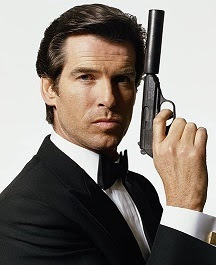
Body Language of James Bond

If James Bond would have ever existed in reality, every intelligence and spy agency on this planet would have tried hard to recruit him by paying the highest compensation ever paid to an agent. Ultimately, our world would have become a peaceful place to live after mafias, arm traders, militias, secret groups, rouge organizations, separatists, smugglers, evil scientists, evil industrialists, extremists, terrorists, traffickers, warlords, warmongers, conspirators, psychopaths, fundamentalists and international criminals brought to justice, punished, put behind bars, pacified, paralyzed and eradicated.

Sadly, this is only a great dream or a finest fantasy that novelists, fiction writers and movie makers show to all of us. Our world is full of multiple threats, dangers and challenges which are posed by several evil-minded, anti-social, psychopathic, rogue and extremely ambitious individuals. We live by dreaming and hoping that someday this much-loved-on-screen secret agent or the super-spy would show up and save us from them and turn the world into a peaceful heaven. That's why we all secretly love him and want him badly around us like a super-hero who never takes credit openly.

James Bond is the adventurous, charismatic and smartest character in the history of world's commercial cinema. This character is depicted as a great people reader, a personality profiler and more specifically a master 'mind reader' who always stays ahead of the curve. Upon confrontation, he can judge people accurately and sense their potential moves quickly. He has a lot of tricks under his sleeves to tackle and fight physically, technically and tactically. He is well-equipped with sophisticated and advanced gadgets, devices and vehicles to assist him in surviving and finishing his missions successfully for his own country and the whole world.

"You only live twice. Once when you are born and once when you look death in the face." - Ian Fleming

He is dropped at very hostile places with minimal yet effective equipment to finish the deadliest operations (to save the world!). Only truly lethal weapon he has is his own brain. His success in missions is highly dependent upon reading a targeted person(s) just by analyzing expressions, gaze, gestures, postures, para-language, fidgeting and movements. He has to make snap and accurate judgments in the given situations and act upon his plans in no time. He mostly acts upon his strong reflexes and precise calculations. He invades, gathers necessary information or intelligence, rescues his love interests and escapes the spot with great speed, elegance and explosions.

We strongly like the way he has been portrayed in movies as a individuals who is cool, calm, confident, calculating, outstanding and in-control of himself most of the time. He puts on costly suits, wears dark glasses and drives fast cars which give him his identity. He aims straightly, shoots precisely, reacts smartly, acts swiftly, chases boldly, fights fiercely and punishes mercilessly. Body language of James Bond is remarkably distinct. He walks slowly, stands confidently, gesticulates rarely, blinks hardly, looks directly, observes meticulously, listens attentively, talks smoothly, speaks firmly and introduces himself uniquely by saying, “My name is Bond…James Bond!”.

James Bond: Celebrating 50th anniversary on screen

In fact, secret agents, undercover officers and spies don't work, look and act not the way they are depicted in novels, movies or TV series or shows. We just can’t watch agents, undercover officers and spies in parties or round the corner as the most handsome and smart super-spy we love does exactly the same in movies. Real life secret agents, undercover officers, spies and detectives don't at all appear, move and walk in public as they are depicted in commercial action movies.

However, what all they have in common is black glasses, goggles or sheds on their eyes most of the time while walking and moving around people so that the people can hardly notice that they are being observed, analyzed and profiled by the expert and experienced eyes which can pick subtle clues from every body movements. It's always worth remembering that Devil lies in details and spy succeeds in disguise.

It's not at all secret that every independent and sovereign state or nation has its own defense framework and infrastructure which is consistently kept on its toes by a group of intelligence and counter-intelligence officers, agents, spies and analysts who work within and beyond the boundaries of the state or the nation to protect its people, government, sovereignty, infrastructure, assets, institutions, boundaries and international relations.

The Master People Readers

Without any shadow of doubt, the secret agents, spies and detectives posses the highest accuracy rates in reading people (and their minds) than ordinary people i. e. about 80 %. It is only achieved by sharper senses, rigorous training given by field experts, strong mental preparation, enhanced observational skills, better knowledge about human behavior, thousands of hours of practice and above all the ability to listen to the gut feelings. Hand-to-hand combat and weapon training is just an addition for self-defense and escape.

There are many famous TV series or shows like Lie to Me (Micro-expression analyst), The Mentalist (A great observer), Byomkesh Bakshi (An Indian equivalent of Sherlock Holmes) and many more which essentially have a protagonist, a hero or a central character of a crime investigator or a detective with sharper observing eyes, greater analytical capability and better judging skills. There might be just a kind of character or a hero in your own country too. Unlike licensed-to-kill agents, they don't prosecute and punish the offenders and criminals on their own and leave the same job to local police and the court.

Sherlock Holmes: Sign of Superiority on the face

Work of a typical crime investigator is mostly confined to visiting crime scenes, collecting samples, analyzing photographs, examining video and audio tapes, interrogating people, tracing suspect and conducting laboratory tests. However, secret agents and spies are like the thinking and moving (and mostly “killing”) machines with definite missions in their minds. They are ready, equipped and prepared to act upon every signal of suspicion, hostility, threat and danger given away by individuals (and their silhouettes and shadows too), entities, circumstances and situations.

Being a successful and long living secret agent or a spy is all about having greater situational awareness, a longer attention span and fanatic fixation on details. Also, an agent or a spy has to be physical strong, athletic, agile, clever, resourceful, adaptive, enduring and technically stronger. Moreover, staying highly motivated, controlling emotions and committed to sacrifice own wishes, urges and desires is critically important.

An ordinary looking individual suddenly turning out to be a secret agent, an undercover agent or a spy right before our eyes is the most thrilling and also threatening because of the typical predatory skills, traits, characteristics and qualities the individual has are sophistication, stealthiness, confidence, cleverness, trickery, coldness, courage, precision, patience, deceptiveness, disguise and extreme speed.

James Bond: A Super-Spy or A Psychopath?

Even though we love the world's most celebrated and watched super-spy James Bond, he has a darker side which we completely ignore while enjoying his presence in the movies which are entirely centered on saving the world and us from evil. James Bond is the best example of a high functioning psychopath who is extremely focused, extreme risk taker and extremely calculating killer.

The REAL James Bond(s)

Ian Fleming
Many of us may not know that Ian Fleming, the maker of James Bond character, was a naval intelligence officer serving for United Kingdom (UK) during World War 2. He and his team spied for Allied forces to defeat Germans (Nazis). What he wrote in novels about the super-spy James Bond was entirely based on his own life and of those individuals who inspired him professionally. Otherwise, he could not have brought that much realistic effects, fineness and details in his scripts.

He worked with and closely observed many secret or undercover agents putting their own lives at fatal risk, almost exactly like his super-spy character does to change the course of world’s history and politics. Few of his team members were working as double-agents too, spying for both Allied forces and Germans. They succeeded in distracting and deceiving Germans (Nazis) by providing false intelligence, inputs or information.

[Special Note: This article is entirely dedicated to all those honorable intelligence officers, counter-intelligence officers, on-ground operatives, undercover officers, secret agents, spies, detectives and investigators.

Many of them sacrificed themselves in their honest, timely and sincere efforts for saving the world from going under the total control of the evil side of the human nature.]

Related Articles:
1) Just by looking at hands and eyes 2) Inside Interrogation Room 3) Observation is the key 4) Women are body language experts 5) My career saving lie detection 6) Body Language of Extreme Psychopath 7) Nonverbal Advantage in Investigation

Botox hampers emotional awareness

Botox (Botulinum toxin) is a new magical substance in shelves of today’s cosmetic therapists and beauticians who cater their "youth-maniac" clients. Given “ever-youthful face” fad in modern metropolitan society and corporate work culture, this medicine helps in vanishing facial wrinkles that are caused by natural aging process, severe illness or abnormalities.

Like its apparent advantages in an impression driven environment, the beneficiary(?) has to weigh a great setback in its social life. As Botox is administered in small patches of skin to make it look young, it ultimately hampers one’s ability to read emotions in others. Exactly How?

Regaining youth or losing emotional ability?

Actually, we all give and get facial feedback unconsciously. It’s not necessary that facial expressions are always noticeable because many a times we try to keep face expressionless. However, unnoticeable muscular activities do occur that can be detected by seasoned eyes or computer software with sophisticated imaging devices.

Remarkable purpose of involuntarily muscular movements is detection of emotions in others. Brain understands emotions in other by simulating corresponding muscular movement on face of an observer. Movements might be too tiny to remain unnoticeable by third person or even two persons who are participating in an emotional melodrama.

Machines can read human emotions. What about us?

Botox paralyzes muscles that cause wrinkles on facial skin and thus face looks reflated and swollen. However muscular movements are inhibited because Botox interferes with signals that brain sends to facial muscles. Though it gives a person so-called youthful look, lack of muscular movements hampers core abilities of expressing and detecting emotions.

A person can find itself as emotionless as if it has been forced to stay poker faced for a long time. A research done by Prof. Dr. David Neal (a professor of psychology at the University of Southern California) underlines side effects of Botox on emotional awareness stating clearly, “If muscular signals from the face to the brain are dampened, you’re less able to read emotions.”

Poker Face: Magnificently Dull
Even though many of us don’t get Botox injected, we don’t capitalize facial muscles at fullest. Staying poker for long time is also likely to hamper our ability to both express and read emotions in others.

Particularly, in the metropolitan environment, where large population is forced to use and share limited physical space, we incline to keep our faces almost emotionless while commuting and staying in or sharing common physical spaces.

It helps us to isolate ourselves from strangers on social grounds but it might hamper our emotional awareness too. Issue gets multiplied by working conditions where casually interaction with others is almost impossible or not (assumed as) required.

In overall body language, maintaining a poker face or not expressing emotions on face could lead us to social devastation.

Related Articles:
1) Face to Face 2) Facial Feedback: World smiles with you! 3) Common Facial Expressions 4) Basic Emotional Expressions 5) Social Footsteps 6) Emotional Intelligence and Success 7) Recognizing emotional expressions: Scientific viewpoints 8) Chicken and Egg Paradox